NotaZone
Product Specifications Simplified
In the food industry, product specifications are more than just paperwork—they're the backbone of quality assurance, safety compliance, and consumer...
Whether you’re moving from SALSA to BRCGS, introducing new equipment, or reshaping how your factory runs, change can be challenging. Many food businesses struggle to decide whether they need to refine existing processes or completely redesign them to move forward. The two approaches sound similar, but they lead to very different outcomes, and choosing the wrong one can cost time, money, and momentum.
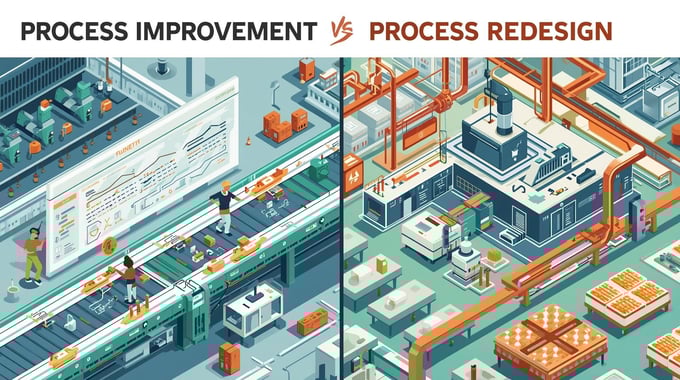
Process improvement focuses on optimising what already exists. It’s about tightening, refining, and elevating current workflows without fundamentally changing their structure.
Minor inefficiencies are slowing production
Waste levels are creeping up
Quality deviations are occurring but root causes are known
Staff training gaps are causing inconsistency
Equipment performance is adequate but under‑utilised
Streamlining changeover procedures
Reducing micro‑stoppages on a line
Standardising sanitation steps
Improving allergen‑control checks
Digitising paper forms to reduce transcription errors
Process improvement is incremental. It’s ideal when the system works, just not well enough.
Process redesign is a fundamental rethinking of how work gets done. Instead of tweaking the current process, you step back and rebuild it to meet new operational, regulatory, or commercial realities.
Regulatory changes require new controls or documentation
New product categories demand different workflows
Legacy processes can’t scale or are no longer fit for purpose
Technology upgrades (e.g., automation, digital traceability) require structural change
Cross‑functional bottlenecks are baked into the current design
Rebuilding the entire allergen‑management system
Designing a new intake‑to‑dispatch traceability flow
Reconfiguring production lines for higher throughput
Introducing automated CCP monitoring
Moving from paper‑based QA to fully digital workflows
Process redesign is transformational. It’s disruptive, but often essential for long‑term competitiveness and growth.
Use the guide below to shape your thinking, but make sure you involve your team in the review and planning. Their day to day experience will surface the real world challenges they face, and they’ll be far more open to change if they’ve been part of the process from the start.
| Scenario | Best Fit |
|---|---|
| The process works but is inefficient | Process Improvement |
| The process repeatedly fails despite fixes | Process Redesign |
| Regulations or customer requirements have changed | Process Redesign |
| You want quick wins with minimal disruption | Process Improvement |
| Technology investment demands new workflows | Process Redesign |
| Staff follow the process inconsistently | Process Improvement |
Food manufacturing is uniquely sensitive to safety, compliance, and consumer trust. Choosing the wrong approach can create:
Compliance gaps if outdated processes are patched instead of rebuilt
Operational drag when teams spend time firefighting instead of producing
Cost escalation from waste, rework, and inefficiency
Cultural fatigue when staff are asked to “fix” processes that are fundamentally broken
A clear decision between improvement and redesign protects both performance and people.
When you frame process improvement vs process redesign specifically through the lens of digitisation and automation, the distinction becomes even sharper, because technology doesn’t just enhance processes, it often redefines what’s possible.
Digitisation tends to start as process improvement:
Replacing paper forms with digital checks
Automating data capture at CCPs
Introducing dashboards for real‑time performance
These are optimisations. They make the existing workflow faster, cleaner, and more reliable.
But once digital capability matures, it exposes the limitations of the old process. That’s when you cross into process redesign territory.
Automation rarely fits neatly into legacy workflows. Instead, it demands:
New sequencing of tasks
Re‑defined operator roles
Different verification and escalation pathways
Integration across departments that previously worked in silos
This is where redesign becomes unavoidable. You’re not just improving the process, you’re rebuilding it around new capabilities.
Most food businesses follow a predictable curve:
Digitise first → quick wins, visibility, fewer errors
Automate second → remove manual burden, stabilise performance
Redesign third → unlock the real ROI
The redesign phase is where you see the big leaps:
End to end traceability that actually works
Integrated allergen management instead of isolated checks

In my time heading up Operations at BakedIn I found it useful to think of process improvement as evolution and process redesign as revolution. Both have their place, and the most resilient food businesses know when to use each.
If your goal is to build a safer, more efficient, digitally enabled operation, mastering this distinction is one of the most powerful levers you have.
In the food industry, product specifications are more than just paperwork—they're the backbone of quality assurance, safety compliance, and consumer...
In the food industry, the “goods in” process is much more than just ticking boxes—it’s your frontline defence for compliance and quality. Whether...
In the high-stakes world of food production, safety isn’t just at the top of the to-do list—it’s the head chef running the whole kitchen. And when it...